
Training and workshops
Building bridges training: Facilitating in times of crises, conflict and polarization
In polarized times, facilitation is not neutral work.
We live in times marked by war, genocide, social fragmentation, and ecological crisis. Hyper-individualism and disconnection have left many of us alienated, from ourselves, each other, and the natural world.
In this context, facilitation becomes more than a method, it becomes a political, cultural, and spiritual practice: We’re called to hold space for difference while staying present with tension, complexity, and care.
Building Bridges is an 8-week experiential training for facilitators, community weavers, educators, and organizers who want to deepen their ability to navigate conflict and polarization. Together, we’ll practice how to hold all voices, without bypassing harm, reinforcing power imbalances, or losing sight of our values.
We invite you into a deep practice of holding tension with justice, compassion, and clarity, starting from within.
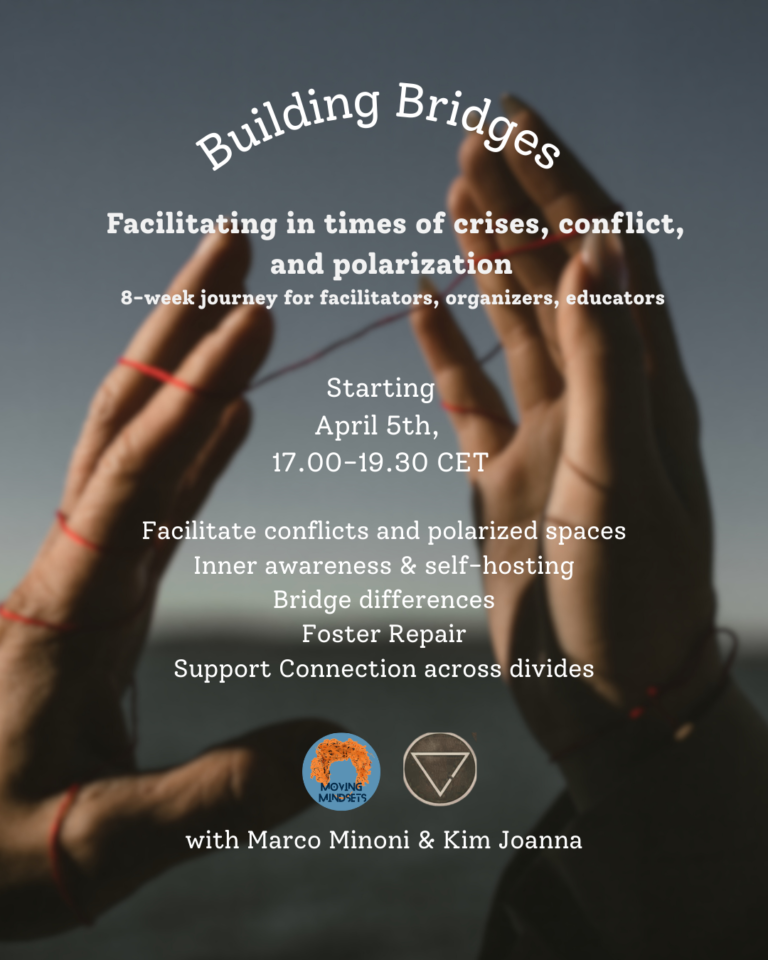
Throughout our journey, we will explore
Hosting Ourselves First
We start within. Learn to recognize your inner tensions and polarizations, build embodied presence, and practice “inner hosting”, so you can stay grounded and steady while holding space for others.
Power, Justice, and Differences
Explore how power and identity shape the spaces we hold. Practice naming structural dynamics with care, and clarify the values that guide you when things get hard, and approach external difference with empathy and curiosity
Facilitating Polarized & Conflictual Spaces
Learn how to navigate tough conversations with courage and compassion. We’ll explore multi-partial tools that help you hold all voices while staying true to your integrity, to cultivate and foster empathy and connection across difference
Repair & Accountability
Rupture happens, this week is about how we respond. We’ll explore repair, accountability, and what it takes to stay in this work with clarity, compassion, and long-term commitment.
What can you expect from this course?
- 6 online Interactive and collaborative Group Sessions lasting 2.5 hours.
- Rich Facilitation Resources: Gain access to an extensive list of facilitation resources, meticulously curated to support your growth as a facilitator.
- Practical Assignments: Engage with practical "homework" assignments designed to prepare you for the sessions, ensuring a rich, hands-on learning experience.
- Access to our community of practitioners: You will join the Moving Mindsets community, a a space that allows you to continue growing alongside fellow facilitators after the course has concluded.
- Free or discounted personalized Individual Session: Benefit from a 40-minute one-on-one session, offering personalized guidance and feedback.
Is this course for me?
This facilitation training course is more than just a learning opportunity; it’s an invitation to join a community of facilitators committed to making a difference.
This is for facilitators who don’t want to leave parts of themselves at the door, who want to bring heart, politics, spirit, and psychology into how they hold space.
It’s for those who want to move beyond either/or thinking, neutrality vs. advocacy, compassion vs. confrontation, and instead practice a facilitation rooted in integration, justice, and care.
This series is designed for anyone navigating group dynamics marked by conflict, power, or deep difference
Whether you’re working in grassroots movements, classrooms, or organizational settings, this course will support you in holding space with more skill, courage, and care.

Your Hosts
Marco Minoni and Kim Joanna are facilitators and social activists passionate about building cultures rooted in care, justice, and authentic connection.
With experience in grassroots organizing, political education, and experiential facilitation, they create spaces where people can:
Practice compassionate and courageous communication
Explore power and privilege
Navigate complexity and difference
Their work is grounded in embodiment, nonviolent communication, and anti-oppressive practice—supporting individuals and groups to show up more fully, and work towards collective liberation.

Next cohort
 April 5th
 17.00-19.30 CET
Contribution within capacity
Solidarity price
This tier supports is for those with financial constraintsStandart price
This is the standard price for the courseSupporter price
If you can, choose this to support others' access.The Roots of This Training
This training is born out of a commitment to navigate the complexities of today’s world (polarization, conflict, injustice, and disconnection) with clarity, courage, and care.
It brings together multiple dimensions of practice that live within us as facilitators:
🧠 The Psychology Self: Rooted in the understanding that behind every action is a need. We explore human behavior, emotions, and social dynamics to build compassion and insight, even in the heat of conflict.
🌍 The Anthropologist: Looks at the cultural and systemic forces that shape how people make sense of the world. We explore structural power, dominant narratives, and cultural conditioning to move beyond binary thinking and into deeper understanding.
🔥 The Activist Self: Brings clarity, direction, and fire. It recognizes that silence can reproduce harm, and that facilitation is never neutral. We explore how to show up with integrity, how to name injustice, and how to take sides, when it matters.
🌌 The Spiritual Self: Holds the sacred, the unseen, and the interconnected. This part reminds us that facilitation is relational, energetic, and often deeply personal. It helps us hold paradox, stay present, and remain grounded in something larger.
Together, these parts shape the Facilitator Self : the one that holds space for individuals and groups, seeks to reduce harm, and stays in service to connection, dignity, and transformation.
FAQ
- Creating safer and brave spaces
- Power dynamics and identity politics in facilitation
- Nonviolent communication
- Addressing power and practicing interventions
- Hosting yourself and others (needs, emotions, and boundaries)
- Group-level interventions and conflict resolution strategies
- Cultivate liberatory imagination and culture-building
- Make decisions from a place of integration and alignment
- Hold space with care when trauma, grief, and fear are present
- Learn to hold paradox and inner conflict, while staying connected to values
Build collective resilience and grounding practices
The course blends non-formal education, experiential learning, somatics, and trauma-informed practices to create an interactive and reflective experience. Expect group exercises, discussions, case studies, and embodied learning practices.
It’s highly practical and experiential—you’ll not only learn about facilitation but practice it in real time, with feedback and reflection.
You will receive a recording to catch up any missed session
Active engagement, curiosity, and self-responsibility for learning. This means showing up on time, participating in exercises, and bringing an open mindset to practice and feedback
Yes, participants who complete the course and actively engage in the learning process will receive a certificate.